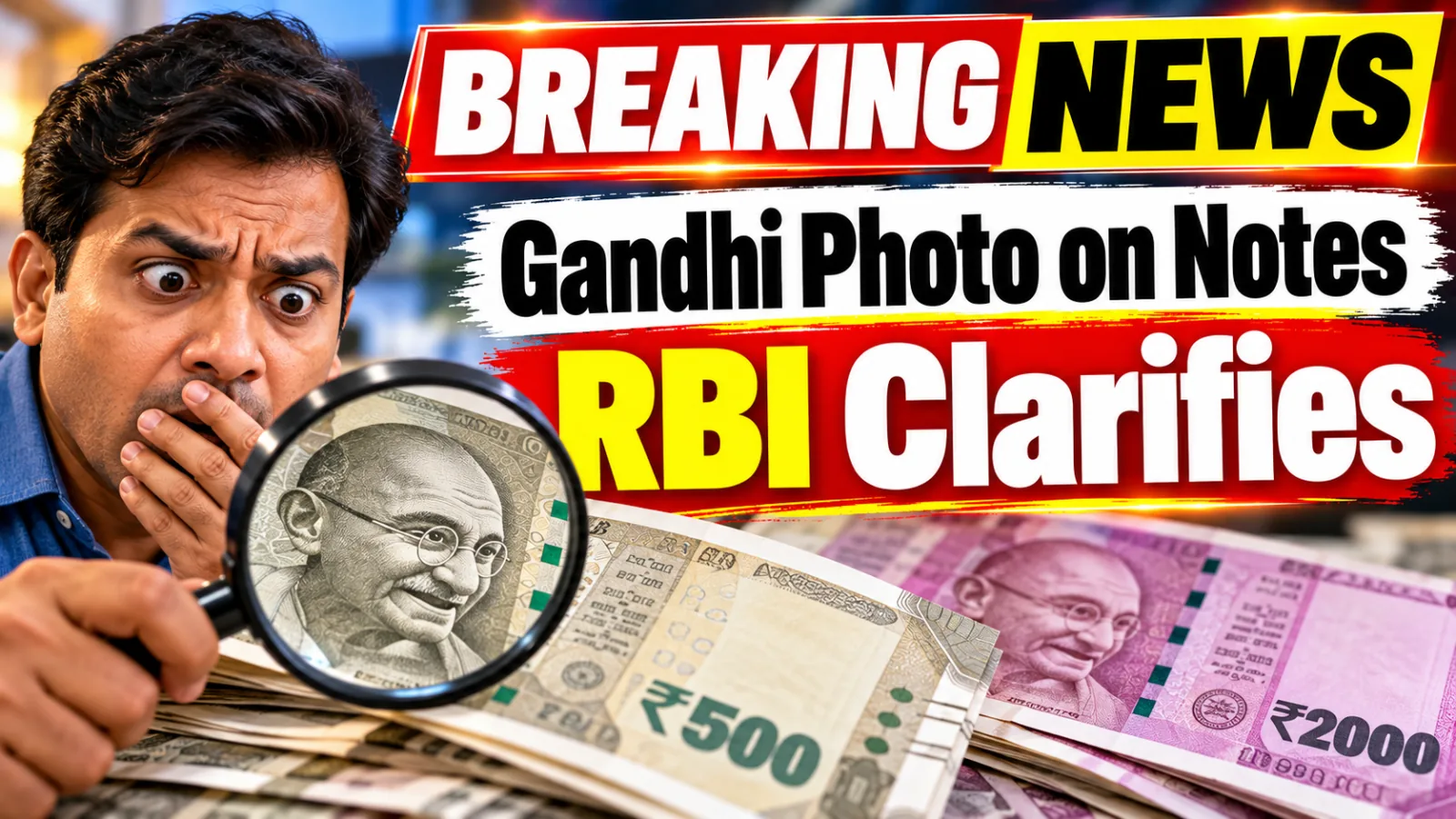
A message doing the rounds on social media claimed that Mahatma Gandhi’s portrait would soon disappear from Indian banknotes. The Reserve Bank of India, whose central office is in Mumbai, has addressed the talk and made its position clear: the Gandhi photo on currency notes is not being removed.
This guide explains the RBI’s clarification on the Gandhi photo on currency notes, how the rumour spread, why the digital rupee confused people, and how you can check such claims yourself before forwarding them to family and friends.
Gandhi Photo on Currency Notes
The table below summarises the main points of the clarification in simple terms, so you can see the facts at a glance.
| Details | Information |
|---|---|
| Issue | Social media claims that Gandhi’s portrait would be removed from banknotes |
| RBI’s position | No plan to remove Mahatma Gandhi’s photograph from currency notes |
| Description of the rumours | Called baseless and unconnected to the bank’s current or future policy |
| First appearance of Gandhi’s portrait | 1996, in the Mahatma Gandhi Series |
| Series it replaced | The Lion Capital series, based on the Sarnath pillar |
| Current notes | The Mahatma Gandhi (New) series keeps the portrait with updated security features |
| Digital rupee | Has no portrait because it is an electronic entry, not a paper note |
| Where changes would be announced | Through official channels of the RBI and the government |
What the RBI Has Said
According to the reports, the Reserve Bank of India issued an official statement after the claims spread online. The central bank firmly denied any plan to take Mahatma Gandhi’s photograph off Indian banknotes and described the rumours as baseless.
The statement also said that the talk has no connection with the bank’s present or future policies. The RBI stressed that any significant change to currency design would be announced only through official channels, and not through forwarded messages.
The central bank further underlined its commitment to the integrity and symbolic value of Indian currency. The portrait is described as a visual reminder of the country’s history and its founding principles, something people carry in their wallets every day.
Alongside the clarification, the RBI advised citizens not to believe unverified information shared on social media. In a time of fast-moving digital rumours, checking the source of a claim is the most useful habit any user can build.
How the Rumour Spread and Why It Gained Traction
The reports say the rumours seem to have started from misunderstood information shared on several social media platforms. Some accounts take advantage of technical updates or small changes in currency features to build misleading stories.
- Misread information: A small update or a technical detail was apparently read as a design change and then forwarded without checking.
- No quick verification: Because no one checked the claim with an official source early on, the story gathered momentum.
- The digital rupee: Many people saw that the digital rupee carries no portrait and wrongly assumed the paper note would change too.
- Speed of social media: News online often moves faster than a regulator can respond, so a false claim can travel far before a correction arrives.
- Emotional symbol: The portrait on the note is a national symbol, so any claim about it spreads quickly and attracts strong reactions.
Why the Digital Rupee Has No Gandhi Image
A large part of the confusion came from the digital rupee. It works on entirely different principles from physical notes. Digital currency focuses on security and technology, not on the visual design that a paper note carries.
Digital payment systems depend on encryption and secure technology, and they do not need a picture. So the absence of Gandhi’s image on the digital rupee does not point to any policy change for physical currency. It is simply a difference in the medium.
Physical notes are tangible money used in daily transactions, while the digital rupee is an entry in a secure electronic ledger. Each format has its own design needs, which is why the two should not be compared on looks.
How to Check a Currency Claim: Step by Step
Before you share any message about notes, coins or banking rules, a quick check takes just a few minutes. Follow these steps whenever a currency rumour reaches your phone.
Step 1: Look for the source
Ask who first said it. A forwarded message with no named source or official link should be treated with caution.
Step 2: Visit the RBI’s official website
Check whether the RBI has published a press release or notice. Important announcements about notes appear on official RBI channels.
Step 3: Compare with trusted news
See whether established news outlets are reporting the same thing, and whether they quote an official statement.
Step 4: Pause before forwarding
If you cannot confirm the claim, do not share it. Citizens are encouraged to be responsible digital users and avoid spreading unverified messages.
Step 5: Ask your bank branch
If you are still unsure, ask staff at your bank branch. They can guide you towards official information about notes and banking.
Gandhi Photo on Notes: What Mumbai Residents Can Do
Mumbai is home to the RBI’s central office, but you do not need to visit any office to confirm a rumour. The RBI website and official announcements are the first places to look.
Shopkeepers, traders and bank customers in Mumbai who handle cash every day should rely on the same official sources. If a customer questions a genuine note because of a viral message, calmly point to the RBI’s clarification.
For a related banking topic that also needed an official check, you can read our article on RBI’s rules on bank accounts.
History: When Did Gandhi’s Portrait First Appear on Notes?
Mahatma Gandhi’s portrait was first introduced on Indian currency notes in 1996, as part of the Mahatma Gandhi Series. It replaced the Lion Capital series, which had been in circulation for decades and was taken from the Sarnath pillar, a symbol of sovereign India.
The decision to feature Gandhi was made to honour the Father of the Nation and to place the leader of the independence struggle on one of the most visible national symbols. Since then the portrait has appeared on various denominations.
The latest Mahatma Gandhi (New) series continues with his portrait, along with enhanced security features and updated designs. This means the familiar look of banknotes remains, whether you use paper or digital forms of the rupee.
Frequently Asked Questions (FAQs)
Will Mahatma Gandhi’s photo be removed from Indian currency notes?
No. The Reserve Bank of India has clarified that there are no plans to remove Mahatma Gandhi’s photograph from banknotes. The portrait will continue to appear as it has since 1996.
When was Gandhi’s image first introduced on Indian currency?
It was first introduced in 1996 as part of the Mahatma Gandhi Series. This replaced the earlier Lion Capital series that had been in circulation.
Why doesn’t the digital rupee feature Gandhi’s image?
Digital currency works differently from physical notes and focuses on technology and security rather than visual design. The absence of the image does not signal any policy change for paper currency.
How did the rumours about currency design changes start?
The rumours reportedly came from misinterpreted information on social media. The lack of quick verification let the baseless claims gain momentum before the RBI clarified.
Where can people in Mumbai verify information about currency changes?
People in Mumbai, as elsewhere, should check official RBI channels and government announcements. Social media is not a reliable source for important news about currency and monetary policy.
Note: This information is based on details available at the time of publishing. Please confirm with the official portal or office.
Official Links
- Reserve Bank of India: rbi.org.in